
A physical therapist’s guide to understanding the brands, design philosophies, and tradeoffs that shape today’s market.
There is no single best barefoot shoe. There are better matches for different feet and different jobs.
A Review, Not Simply a Buying Guide
Most barefoot shoe articles begin with a ranked list and a row of affiliate links. That format can be useful, but it often ignores the most important question: what is each brand actually trying to accomplish?
I reviewed current models, official specifications, construction, fit descriptions, independent testing, and long-term owner patterns across established and emerging brands. I did not personally wear-test every model, so the comments below distinguish between direct experience, published specifications, and a reasoned assessment of intended use.
How I Evaluated Each Company
I focused on the factors that matter for active daily use rather than running performance: actual toe shape, width, midfoot volume, heel lockdown, sole flexibility, stability for lifting, lateral containment, walking comfort, hiking traction, materials, durability, repairability, styling, value, and the practicality of ordering and returning shoes in the United States.
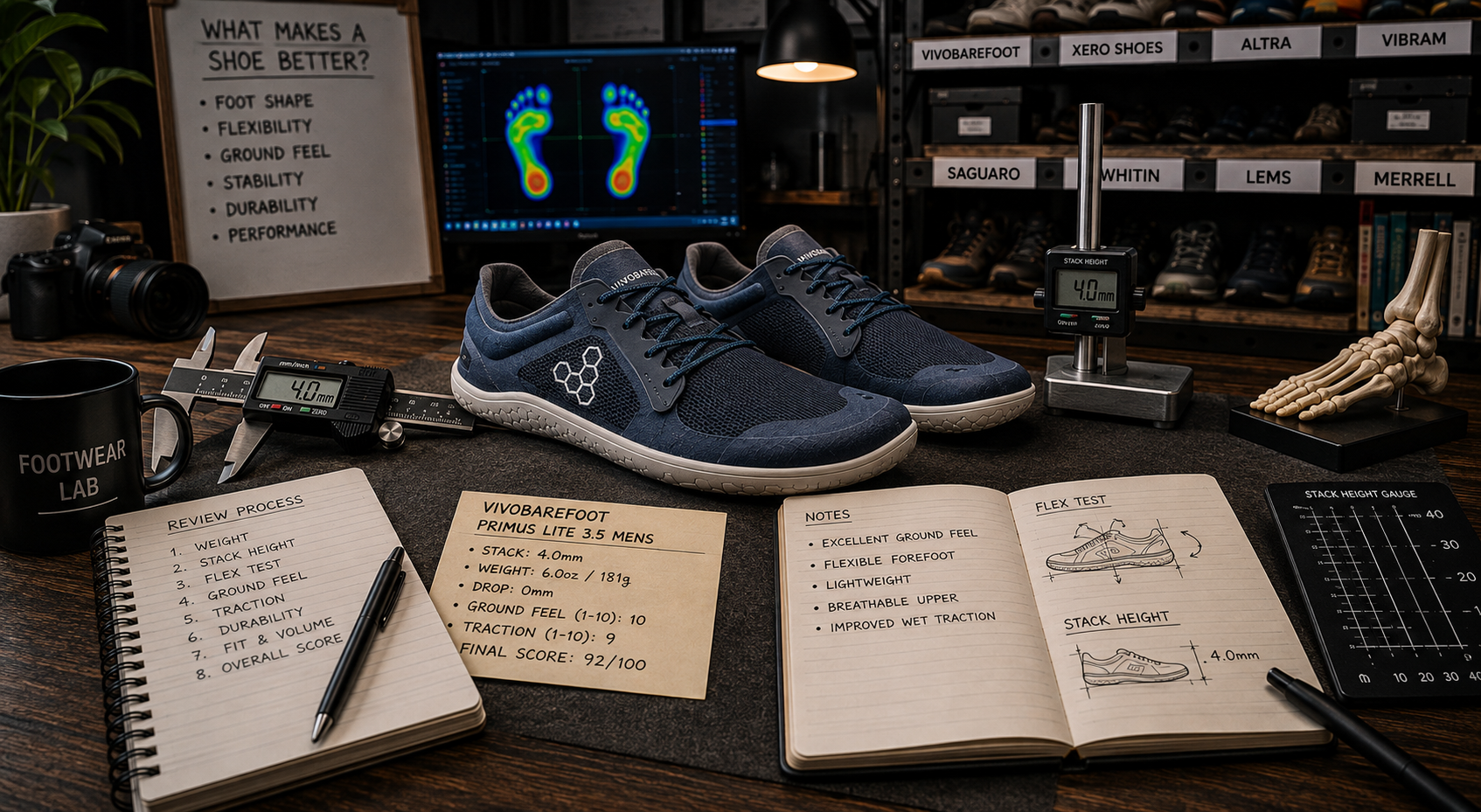
The Modern Barefoot Shoe Market: The Brands That Stand Out
The Training Room Footwear Lab • Volume VIII of VIII
-
Tolos
Tolos is one of the most interesting newer companies because its flagship Archetype is designed as a gym, travel, and everyday shoe rather than a specialized running product. The current Archetype 3.0 is low, flexible, clean-looking, and far easier to wear with normal clothing than many visibly anatomical shoes.
Its greatest strength is balance. The sole is stable enough for weight training, the upper provides meaningful heel and midfoot security, and the overall package is light enough for everyday movement. It is also one of the better options for controlled agility because the foot is less likely to slide independently of the outsole than it would in a loose leather moccasin or soft knit lifestyle shoe.
The limitation is terrain. Tolos is not the shoe I would choose for wet, rocky, or loose hiking. It is also wide rather than maximally wide; very square or fan-shaped feet may find Realfoot, Softstar, or some Freet models more accommodating.
Best suited for: everyday wear, lifting, functional training, travel, walking, and light agility.
Overall impression: one of the best single-shoe compromises in the category.
TYR: A Performance-First Barefoot Trainer
TYR brings a mainstream strength-and-conditioning perspective to barefoot footwear, with the DropZero family built specifically around training.
The newer DropZero 2 Lace Barefoot Trainer is the model I find most relevant to the Footwear Lab. It uses a 0 mm platform, anatomical wide toe box, thin flexible sole, breathable knit upper, TYRTAC rubber traction, and a molded external TPU heel counter intended to improve rearfoot lockdown and multidirectional stability.
TYR is trying to solve one of the harder barefoot-shoe problems: preserving toe freedom and ground connection without making the shoe feel loose during athletic movement.
This is not the shoe I would select primarily for distance running, technical hiking, or formal everyday wear. It is optimized around gym performance, and fit still needs to be judged foot by foot.
I have not personally tested the TYR lineup yet, but it is high on my list. The DropZero 2 may be particularly compelling for someone whose primary goal is dedicated training. For my broader gym-to-everyday needs, the Tolos Archetype 3.0 remains my current choice.
Best suited for: lifting, functional fitness, balance work, and gym-based agility.
Vivobarefoot
Vivobarefoot remains one of the most refined and technically developed companies in the market. Its athletic models provide excellent ground feel, polished construction, and better multidirectional containment than most casual barefoot shoes. The Motus Strength line is particularly relevant for lifting, functional fitness, and gym-based agility.
The tradeoffs are price and fit. Vivo’s shoes are wider than conventional athletic footwear, but many models are not among the widest barefoot options.
Best suited for: dedicated gym use, refined barefoot feel, and people with average-to-wide rather than extra-wide feet.
LONO Flow 2
A compelling all-around barefoot gym shoe with a wider toe box, stronger lateral structure, and a more secure heel.
The Flow 2 deserves a place in the Footwear Lab because it sits between a pure minimalist shoe and a more structured cross-training shoe. LONO redesigned the original Flow around cross-training, strength and mobility work, running, and everyday movement. The result remains thin, flat, and highly flexible, but adds features intended to make the shoe more useful when training intensity rises.
Compared with the original Flow, the Flow 2 has a wider toe box and higher midfoot volume, a reinforced TPU toe cap, reinforced sidewalls, and an enhanced heel cup. Those sidewalls are specifically intended to reduce foot spill during lateral movement, while the revised heel is designed to improve lockdown without turning the shoe into a rigid trainer.
The new 'Be Water' outsole uses a 3 mm rubber base with 2 mm tread and approximately 95% ground-contact area. A removable 2 mm performance insole lets the wearer choose between a little more cushioning and an even more direct ground feel. That combination makes the Flow 2 particularly attractive for squats, deadlifts, unilateral strength work, sled work, jumps, general conditioning, and mixed gym sessions.
What interests me most is the balance. The Flow 2 gives the toes meaningful room and preserves the sensory, flexible character I want from barefoot footwear, while addressing two weaknesses that can show up in very soft minimalist shoes: lateral containment and heel security. I would still favor a more purpose-built trainer such as the Vivobarefoot Motus Strength line when aggressive cutting, repeated multidirectional work, and maximum lateral containment are the priority. But for someone who wants one barefoot shoe to handle most of the gym, the Flow 2 belongs very high on the list.
Xero Shoes
Xero has earned its position through broad availability, reasonable pricing, a large model range, and durable outsole rubber. The Prio remains a strong general-purpose training shoe.
Xero shoes tend to be wider than conventional shoes but are not consistently the widest within the barefoot category. Their great advantage is practicality: purchasing, exchanging, and replacing shoes in the United States is generally easier than ordering from a small European manufacturer.
Best suited for: value-conscious buyers, general gym use, walking, travel, and people who want a large, accessible product range.
Bearfoot
Bearfoot is unapologetically strength-training oriented. Models such as the Ursus provide a broad, flat, stable base appropriate for heavy squats, deadlifts, carries, and general strength work.
Its specialization is also its limitation. It makes more sense as a dedicated gym shoe than as the only shoe in a minimalist rotation.
Best suited for: lifters who prioritize platform width and stability above walking comfort or style.
Merrell
Merrell helped introduce minimalist footwear to a mainstream audience. The Vapor Glove remains among the thinnest and most flexible options sold by a major outdoor company.
That extreme ground feel makes it useful for experienced minimalist users, lifting, and short controlled exposure. The same qualities make it a poor transition shoe for someone immediately attempting normal training volume.
Best suited for: experienced minimalist wearers who actively want very low stack and high sensory feedback.
Astral
Astral is not marketed primarily as a barefoot company, but its water-oriented footwear often combines low stack, flexibility, drainage, and excellent wet-surface traction.
Best suited for: water, travel, warm-weather outdoor activity, and wet traction.
-
Freet
Freet may be the most underrated all-around company in the market. Its catalog covers sport, daily wear, hiking, winter, and casual use, with many models accommodating wider and higher-volume feet.
The Pace is particularly versatile because its removable cushioning creates a protected configuration for hard surfaces and a more minimal configuration for lifting and balance work. For hiking, the Feldom line offers true trail tread without turning into a rigid conventional boot.
Best suited for: wide or higher-volume feet, people who want one brand across multiple activities, walking, gym use, and hiking.
Realfoot
Realfoot makes one of the clearest statements about anatomy in the entire industry. Its shoes provide exceptional space around all five toes rather than merely widening the shoe at the ball of the foot.
The extreme forefoot shape is not universally ideal. Narrow, tapered feet may have unused space, and heel or midfoot security must still be evaluated carefully.
Best suited for: square, fan-shaped, or exceptionally broad forefeet; people prioritizing toe freedom above conventional appearance.
Softstar
Softstar’s Primal last is among the widest and most anatomically honest designs available. The Megagrip Primal RunAmoc combines a highly accommodating upper with a serious outsole compound.
It is expensive and visually distinctive, and the soft upper is not my first choice for repeated fast lateral cuts.
Best suited for: extra-wide feet, natural toe spread, leather construction, and hiking or outdoor use.
Wyde
Wyde is built around broad, foot-shaped lasts and a clean Scandinavian aesthetic.
Best suited for: wide feet, everyday wear, and buyers who want anatomical geometry in a relatively polished package.
Be Lenka
Be Lenka offers one of the largest collections of barefoot footwear, including casual sneakers, boots, dressier options, and children’s shoes. Many models are wide, but the lasts differ meaningfully, so the brand should be evaluated model by model.
Best suited for: broad lifestyle selection, casual wear, boots, and families seeking adult and children’s options.
Splay
Splay has helped make broad, flat, casual footwear more accessible at a lower price.
Best suited for: casual use, families, budget-conscious buyers, and people who want a familiar canvas-shoe aesthetic.
Ahinsa and Mukishoes
Both emphasize flexibility, low weight, and natural materials or vegan construction. Their soft structure is less ideal when strong lateral containment, rugged trail traction, or abrasion resistance is the priority.
Best suited for: casual movement, flexible footwear enthusiasts, and buyers prioritizing materials and sensory freedom.
-
Lejan
Lejan represents a newer design philosophy: preserving barefoot mechanics while disguising the shoe as a premium mainstream sneaker.
Best suited for: professionals, travel, casual wear, and people who want a barefoot shoe that does not advertise itself visually.
Barebarics
Barebarics produces substantial, fashionable sneakers that look closer to modern streetwear than traditional minimalist footwear. They offer broad forefeet and zero-drop construction but often feel heavier and firmer than true ultra-minimal shoes.
Best suited for: style-focused everyday wear and buyers who prefer a more substantial sneaker.
Feelgrounds
Feelgrounds has become one of the most recognizable lifestyle barefoot brands because its shoes look clean, simple, and familiar. The Move line is more relevant for active use because it provides better security and grip than the softest casual models.
Best suited for: casual wear, travel, office-casual settings, and light activity.
Groundies
Groundies offers a wide range of familiar sneaker and boot silhouettes, but fit varies. The Barefoot+ line is generally more relevant for people seeking meaningful forefoot width.
Best suited for: fashion-conscious buyers who are willing to investigate model-specific fit.
Origo
Origo combines simple leather and canvas designs with low, flexible soles and an emphasis on materials.
Best suited for: casual and professional wear, minimalist wardrobes, and buyers who prioritize materials.
Bohempia, Birchbury, Peerko, and Shapen
These brands occupy different corners of the style-first market. None would be my first recommendation for a single active shoe. All are valuable because they allow people to maintain foot-shaped geometry in settings where an athletic trainer is inappropriate.
Best suited for: work, dress, casual style, and building a complete foot-shaped wardrobe.
-
Best Barefoot Running Shoes
Running is one category where I do not believe there is a single “best” barefoot shoe. The right choice depends heavily on the runner’s experience, mileage, terrain, foot shape, and adaptation to minimalist footwear. For someone transitioning from a conventional running shoe, the Lems ZENSPEED Lite provides a useful bridge with considerably more cushioning, a 2 mm drop, and a foot-shaped platform, although I consider it a transitional natural-running shoe rather than a true barefoot shoe. The Freet Pace takes another step toward minimalism and is particularly interesting because its removable insole allows the runner to progressively reduce cushioning within the same shoe. From there, the Xero HFS II is an excellent everyday barefoot road runner, while the Merrell Vapor Glove 6 moves toward the more minimal end of the spectrum with exceptional flexibility and ground feel. The Vivobarefoot Primus line offers another refined minimalist option with a more structured upper and excellent sensory feedback.
For runners already well adapted to minimalist footwear, there are several more specialized choices. The lightweight Xero Speed Force II is particularly well suited to faster running, intervals, and strides, while the Vibram FiveFingers V-Run remains one of the purest expressions of barefoot running by allowing each toe to move independently. Trail runners have their own options: the Merrell Trail Glove 7 & the Vivobarefoot Primus Trail FG both add protection and traction while retaining minimalist characteristics, while Freet Feldom provides a versatile barefoot platform for mixed trails and the more aggressive Freet Calver is better suited to steep, muddy, or technical terrain. Rather than ranking these shoes from best to worst, I prefer to view them as a continuum: ZENSPEED Lite → Freet Pace → HFS II/Primus → Vapor Glove/Speed Force/V-Run, with Feldom, Calver, and Trail Glove addressing off-road demands. The farther a runner moves along that continuum, the less the shoe does and the more the runner’s own foot, ankle, calf, and Achilles are being asked to manage—which is exactly why progression and individual readiness matter as much as the shoe itself.
My Personal Take
From a purely functional standpoint, I still believe it is difficult to find a better shoe for running, cutting, agility, and multidirectional movement than Vibram FiveFingers. Allowing each toe to move independently while providing very little interference between the foot and the ground creates an experience that is probably as close as you can get to performing barefoot while still wearing a shoe. For an athlete who has appropriately adapted to minimalist footwear, I think there is something uniquely effective about being able to grip the ground, spread the toes, and allow the entire foot to participate in movement.
My hesitation with FiveFingers has never really been about performance—it is the aesthetics. As much as I appreciate what the shoe allows the foot to do, I still have a difficult time getting past the individual-toe appearance, particularly as an everyday shoe. If I were judging footwear strictly on function and completely ignoring how it looks, FiveFingers would rank near the very top of my list. Unfortunately, I am apparently still vain enough to care what my shoes look like.
-
Lems
Lems remains one of the best gateways into minimalist footwear. Models such as the Primal Zen and Primal 3 provide a wide toe box and level platform while retaining enough material underfoot for long pavement walks and all-day wear.
This makes Lems less “pure” than the thinnest barefoot brands but often more practical.
Best suited for: transition, walking, travel, lifting, and people who want more protection without returning to a conventional tapered shoe.
Flux
Flux combines anatomical forefoot geometry and zero-drop platforms with noticeably more cushioning. It is best considered a natural-shape or transitional brand rather than a true barefoot company.
Best suited for: longer walking days, people who want cushioning without toe compression, and gradual transition.
Altra and Topo Athletic
Altra and Topo are not true barefoot brands. They are included because they have helped normalize anatomical toe boxes in running and walking footwear.
Their cushioning changes the biomechanical experience substantially compared with a Vapor Glove, Tolos, or Freet. For some people, that is exactly the point.
Best suited for: running, long-distance walking, transition, and people who need greater underfoot protection.
-
There are several companies now attempting to solve this problem, and they approach it differently. Carets is particularly interesting because the shoes are intentionally designed to preserve the visual proportions of a conventional men’s dress shoe while creating considerably more room for the foot inside. Birchbury takes a slightly more casual approach and can bridge the gap between business-casual and formal wear. Zaqq offers an unusually large collection of barefoot shoes with more traditional European dress styling. Be Lenka and Feelgrounds also offer options that move minimalist footwear into cleaner, more polished territory.
Yes. If the category is specifically “barefoot dress shoes I could legitimately wear with a suit,” I’d be stricter than a generic business-casual list. After checking the current offerings, these are the five I’d start with:
Carets APOLLO Cap-Toe Oxford — This is probably the best execution of the concept we just described. It has a true cap-toe Oxford appearance and a convincing faux heel, while the foot sits zero-drop inside. Carets specifically designs the toe box to disguise its extra width rather than broadcasting the barefoot shape.
Birchbury Brenston — Birchbury
Probably the best balance of dressy + understated + barefoot. Full-grain leather, wide toe box and zero drop, but without looking excessively minimalist. Birchbury explicitly positions the Brenston as its professional dress shoe.Vivobarefoot Ra III — Vivobarefoot
More obviously barefoot than the first two, but a very established option. The Ra line gives considerably more anatomical toe-box space and works particularly well for business casual or a less formal suit. A current 2026 dress-shoe roundup ranks the Ra III first overall.Be Lenka Elite — Be Lenka
A polished leather option that I’d include because it pushes closer to traditional dress styling while retaining barefoot geometry. It also gives us a European brand and a somewhat different aesthetic from Carets/Birchbury. It’s currently included among the leading barefoot dress models for 2026.Lems Nine2Five — Lems Shoes
This is the least formal of my five, but I think it belongs in the article because it’s a very practical work/business-casual entry point. I wouldn’t choose it over the Carets for a dark suit at a wedding, but with chinos, slacks, or a more casual suit it makes sense. It’s also useful because many readers entering barefoot footwear will recognize Lems.
-
For kids who are new to barefoot footwear, I generally like starting with a transitional shoe that gives the toes more room and allows more flexibility without immediately putting the child into the thinnest, most minimal sole possible. Merrell Bare Steps is one of my favorite entry points, particularly for younger children, because of its extra-wide toe box, rounded outsole and flexible construction. Other approachable options include Ten Little, Splay, and See Kai Run, depending on the child’s foot shape. These can be a practical bridge away from stiff, narrow conventional sneakers before moving toward more minimalist footwear.
As the child becomes comfortable with less structure and more ground feedback, I would move toward true barefoot models. SAGUARO offers affordable, very flexible options, while Xero Shoes Prio Kids provides a more athletic barefoot shoe. At the more minimalist end, Vivobarefoot Primus Sport is one of my favorites: lightweight, highly flexible and designed to allow the foot to grip, balance and move with minimal interference. The progression doesn’t need to be rigid—Merrell Bare Steps → Ten Little/Splay → SAGUARO/Xero Prio → Vivobarefoot Primus is a useful spectrum, but ultimately the best shoe is the one that matches the individual child’s foot, activity and needs.
-
Best overall active-lifestyle compromise: Tolos Archetype 3.0
Best broad all-around brand: Freet
Best dedicated gym & agility option: Vivobarefoot Motus Strength
Best strength-specific platform (powerlifters): Bearfoot Ursus
Best emerging All-Around Gym Shoe: LONO Flow 2
Best for the widest toe box: Softstar Primal
Best for hiking: Softstar Primal RunAmoc Megagrip
Best Barefoot Running Shoe: Xero HFS II
Best barefoot running shoe to Transition with: Lems ZENSPEED Lite
Best Trail Runner: Vivobarefoot Primus Trail FG
Best lifestyle appearance Brand: Lejan
Best easy transition: Lems Primal Zen
Best value: Xero Prio
Best everyday sandal for Adults: Xero Z-Trek
Best Adult outdoor adventure sandal: Bedrock Cairn Evo
Best shoe for kids: Xero Prio Kids
Best sandals for kids: Xero Z-Trail Kids
Best cushioned foot-shaped transition: Altra Escalante
Best for Formal Suit: Carets Apollo
Best for Business Suit: Vivobarefoot Ra III
Best Business casual: Lems Nine2Five
Best All-around Toe Sock: Injinji Lightweight Run
Best Toe socks for Sports & Cleats: Tabio Football Socks
What I Would Choose
For one pair intended primarily for everyday wear, lifting, walking, and light agility, Tolos is the most balanced choice.
For a two-pair rotation, I would combine Tolos with the Freet Feldom for hiking and dirty outdoor use.
For exceptionally wide feet, I would start with Freet or Realfoot for daily wear and add the Softstar Megagrip for rugged terrain.
Final Thoughts
The most encouraging result of this review is not that one company won. It is that consumers now have enough choices to stop forcing every foot and every activity into the same design.
The best company depends on whether the priority is performance, anatomy, style, protection, or terrain.
That diversity is the real progress.
Footwear Lab Insight
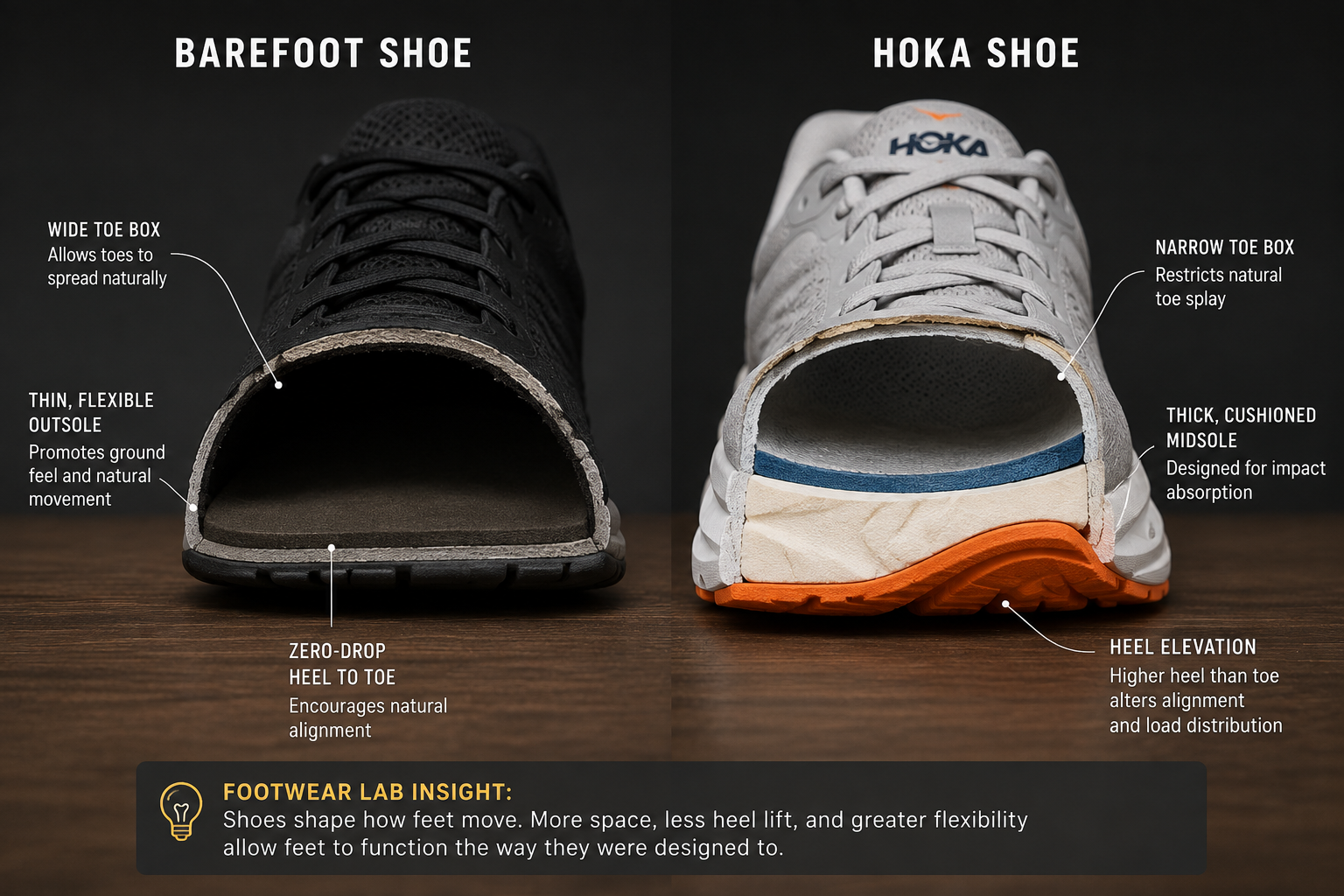
Width is only one dimension of fit. Toe geometry, midfoot volume, heel security, flexibility, traction, and intended use matter just as much.
Key Takeaways
Companies prioritize different problems: performance, anatomical width, lifestyle appearance, hiking traction, transition comfort, or price.
A ranked list is less useful than understanding who a shoe fits, what it does well, and where it compromises.
Model-level fit matters more than brand reputation because lasts and volumes can vary within the same company.
Return to The Footwear Lab Homepage