
Barefoot vs. Cushioned Footwear: What The Research Actually Says
The Training Room Footwear Lab • Volume III of VIII
The Evidence Is More Interesting Than Either Side Admits
Barefoot footwear debates often begin with a conclusion and work backward. Advocates cite natural movement and foot strength. Critics cite injury reports and the comfort of modern cushioning. The research does not support a universal winner.
What minimalist footwear tends to change
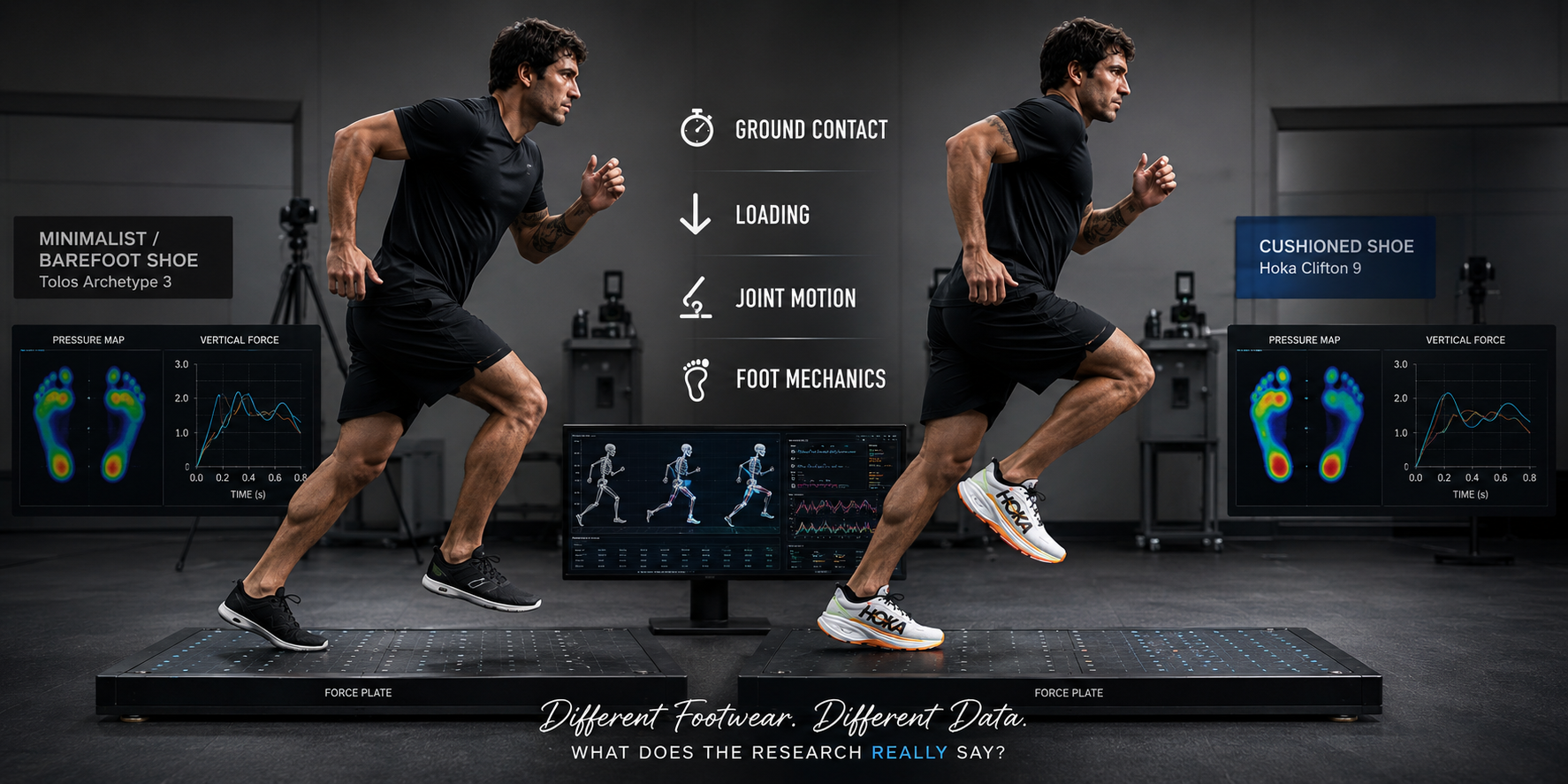
Compared with conventional shoes, barefoot or highly minimalist conditions often produce shorter stride length, higher cadence, a foot strike closer to the body, increased ankle motion, and greater demand on the calf-Achilles-foot complex. These changes are common tendencies, not guarantees.
Minimalist use may also increase intrinsic foot muscle size or strength over time. Recent reviews suggest a potentially positive effect, although studies vary in design, duration, footwear definition, and participant experience.
What happens at the joints?
Some studies show reduced loading measures at the knee under barefoot or forefoot-strike conditions, while ankle and Achilles loading may increase. This is best understood as redistribution rather than elimination of force.
A runner whose knee symptoms improve may still develop calf, Achilles, or metatarsal symptoms if the transition is too abrupt. The location of load changes with mechanics, speed, fatigue, anatomy, and footwear.
Does cushioning reduce injury?
Cushioning can improve comfort and may improve running economy in certain modern racing shoes. That does not automatically mean it prevents injury across all runners. Injury is influenced by training load, previous injury, sleep, strength, tissue capacity, biomechanics, surface, and footwear comfort. That brings me to my next point.
The Comfort Trap: Comfort vs. Stability
Softness, support, and stability are not the same thing - and a brief try-on tells us very little about how a shoe performs in motion.
The shoe-store test can be misleading
Put on a thick, highly cushioned shoe and stand there for thirty seconds. It will probably feel fantastic. The foam compresses, pressure is distributed, and the immediate conclusion is easy: if this feels this good standing here, imagine how good it will feel all day. But standing in a shoe for thirty seconds is not how we use our feet.
I compare it to sitting on a couch
When you first sink into a comfortable couch, it feels incredible. Your body relaxes and the couch supports you. That does not necessarily make it the ideal place to spend the next eight hours. Immediate comfort and long-term movement quality are not necessarily the same thing.
Comfort, cushioning, support, and stability are different
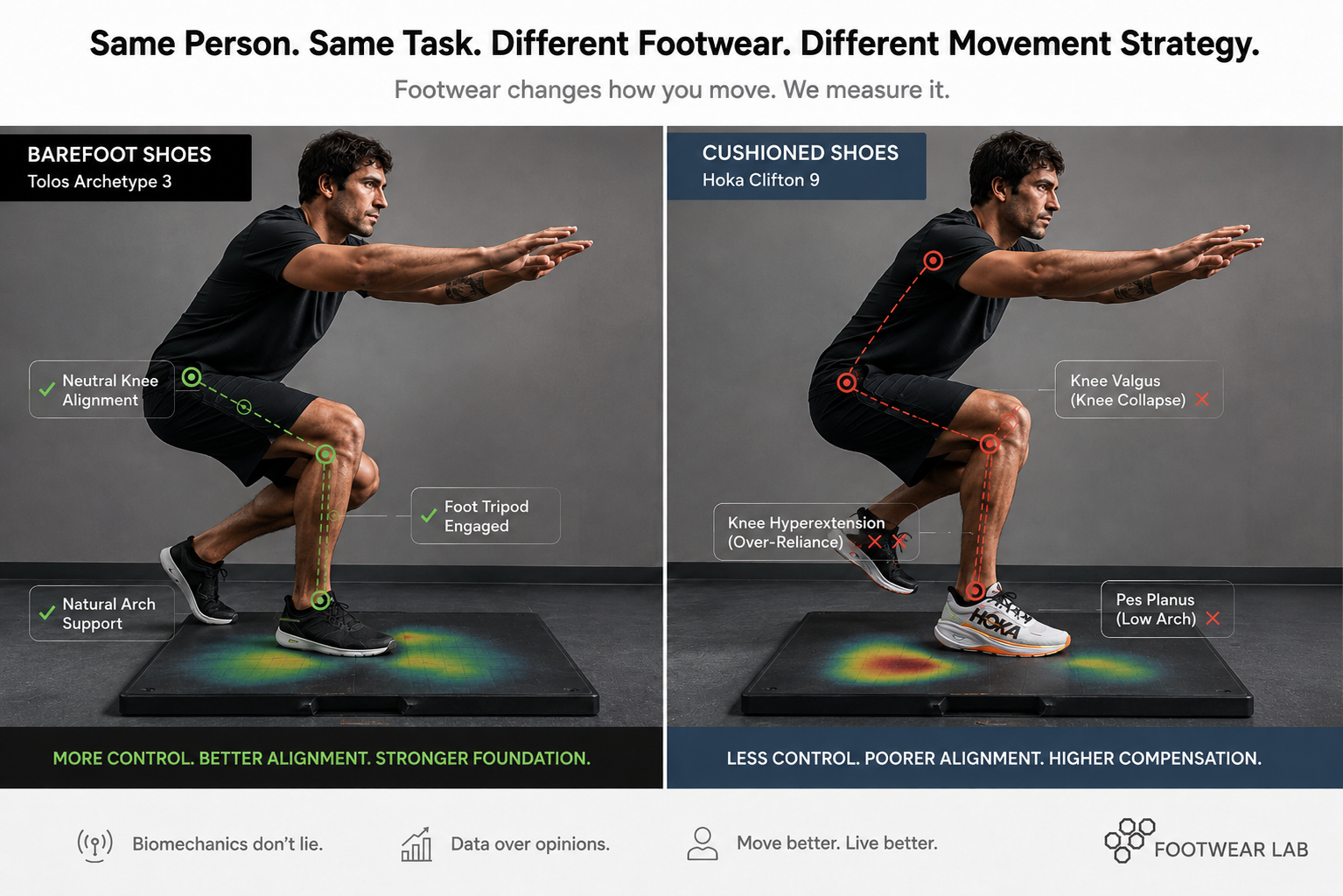
A shoe can feel incredibly comfortable without necessarily making you more stable. Likewise, a wide, relatively flat shoe with very little traditional arch support may give the foot an excellent base from which to create its own stability. A tall, soft shoe may contain considerably more cushioning and supportive technology while also placing more material between the foot and the ground. None of those features is inherently good or bad; they change the environment in which the body has to move.
More shoe does not automatically create more control
Cushioning can reduce pressure, alter loading, improve comfort, and make certain activities more tolerable. I intentionally recommend more cushioning in some situations. But more foam does not guarantee better control of the foot, ankle, knee, or hip. Stability ultimately depends on the interaction between the shoe, the surface, the task, and the person wearing it.
Test the shoe by moving
Walk. Squat. Balance. Lunge. Perform a calf raise. Jog. Change direction. Jump and land when appropriate. Can you create a stable base? Can your toes contribute? Can you control your arch? Do your knees and hips organize well over your feet? For someone already comfortable moving barefoot, a useful question is: does this shoe allow me to move similarly to how I know my body can move barefoot?
FOOTWEAR LAB INSIGHT
Comfort matters. Cushioning can be useful. But do not ask only, "How comfortable is this shoe?" Ask, "How well can I move in it?"
Does barefoot running prevent injury?
There is not enough high-quality evidence to claim that barefoot or minimalist running prevents injury overall. Earlier systematic reviews found that the risks and benefits were not clearly established. Transition-related injuries are a recurring concern, particularly when runners abruptly replace normal mileage.
Foot strength
This is one of the more promising areas. Minimalist footwear and targeted foot exercises may increase foot muscle strength or size. Even here, the practical meaning is not that every person needs to run barefoot. Strength benefits can be pursued through exercise, walking exposure, and selective minimalist use.
Running economy and performance
Modern high-stack plated shoes can improve running economy for many athletes. Ultra-minimal shoes reduce shoe weight but may increase muscular cost for runners who are not adapted to them. Performance and tissue training are separate goals; the best racing shoe may not be the best shoe for developing foot capacity.
Children
Research on children’s footwear suggests that shoes can influence gait and foot motion, but long-term developmental conclusions remain more limited than marketing claims imply. A reasonable evidence-informed approach is to prioritize fit, toe room, appropriate flexibility, activity-specific protection, and time spent moving in varied environments.
The most defensible conclusion
Barefoot shoes are neither a cure nor a threat by default. They are a footwear category that changes sensory input and mechanical demand. Cushioned shoes are neither inherently harmful nor mechanically neutral. They alter the interface between the person and the ground in different ways.
The best decision considers comfort, history, activity, foot shape, symptoms, and current capacity. For many people, the most useful strategy is not choosing a side but using multiple types of footwear intentionally.
Clinical takeaway
A shoe should be selected for the person and the task. If a patient wants more toe room, a foot-shaped shoe can provide that without requiring the thinnest possible sole. If the goal is foot strengthening, minimalist exposure can be progressed like any other exercise. If the goal is marathon performance, cushioning and running economy may deserve greater priority.
The research supports thoughtful experimentation—not ideology.