
Toe spacers, toe socks, and why giving your toes room may matter more than you think.
The Overlooked Layer Inside the Shoe
One of the central ideas throughout the Footwear Lab is that the toes are not simply passengers at the end of the foot. They contribute to balance, stability, propulsion, sensory feedback, and the way the arch functions under load. This is one of the primary reasons I place so much emphasis on a foot-shaped toe box.
But there is an obvious problem that is rarely discussed:
What happens when you put a wide, foot-shaped shoe over a sock that is still squeezing all five toes together?
The Sock Is Part of the Footwear System
Most people spend tremendous amounts of time thinking about their shoes and almost no time thinking about their socks. A conventional sock is elastic. Depending on its shape, size, material, and compression, it can place pressure across the forefoot and encourage the toes to sit closer together. That does not mean every conventional sock is harmful, nor does current research prove that ordinary socks cause toe deformity. It does mean that the sock should not automatically be treated as biomechanically irrelevant.
A 2026 systematic review of 25 studies concluded that socks are an active component of the foot-footwear system. Sock design influenced plantar pressure, impact attenuation, sensory input, postural control, and in-shoe movement, although study quality was limited and the effects varied by sock design and population.
The evidence does not yet tell us that toe socks are superior for long-term foot health, but it gives us a good reason to pay attention to the layer sitting directly against the foot.
Why Toe Position Matters
The great toe is particularly important during gait. As the body progresses over the foot, great-toe extension contributes to the windlass mechanism, helping tension the plantar fascia and allowing the foot to become a more effective lever for propulsion.
The lesser toes also contribute to stability, balance, force production, and interaction with the ground.
A wide toe box creates the space for those functions. It does not automatically create the capacity to use that space. That distinction is important throughout this article.
Toe Socks: A Simple Idea That Makes Sense
Toe socks separate each toe into its own compartment rather than wrapping all five toes together inside one elastic sleeve. I like the concept because it is consistent with the reason we choose foot-shaped footwear in the first place: give each toe room to move independently.
I would be careful about overselling toe socks as a medical intervention. Direct evidence showing that toe socks strengthen the foot, restore alignment, or prevent injury is limited.
For someone who has deliberately chosen a wide toe-box shoe because they want less restriction, however, it is reasonable to ask whether the sock inside that shoe is preserving that room or partially taking it away.
Toe Spacers: Why Everyone Is Talking About Them
Toe spacers have become one of the hottest products in the barefoot and foot-health world.
The concept is simple: instead of merely providing room around the toes, a spacer physically encourages separation between them, most noticeably between the great toe and second toe.
I think toe spacers can be useful. I do not think they are magic.
Putting a spacer between the toes does not automatically strengthen the foot, correct gait, rebuild an arch, or permanently reverse years of structural adaptation.
What a spacer can provide is a temporary positional stimulus. For some people, that can be valuable.
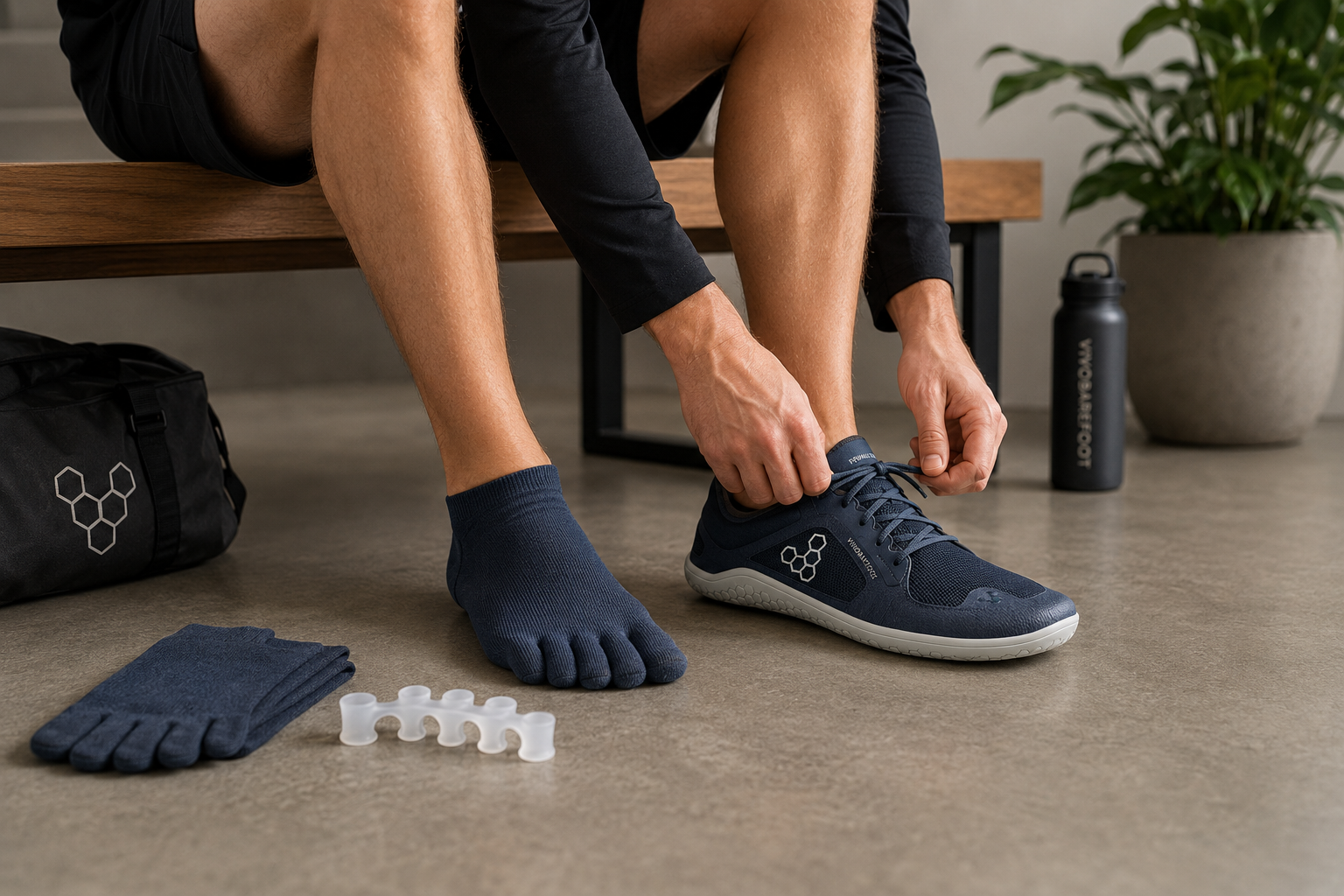
Your Shoes Aren’t the Only Thing Squeezing Your Toes
The Training Room Footwear Lab • Volume II of VIII
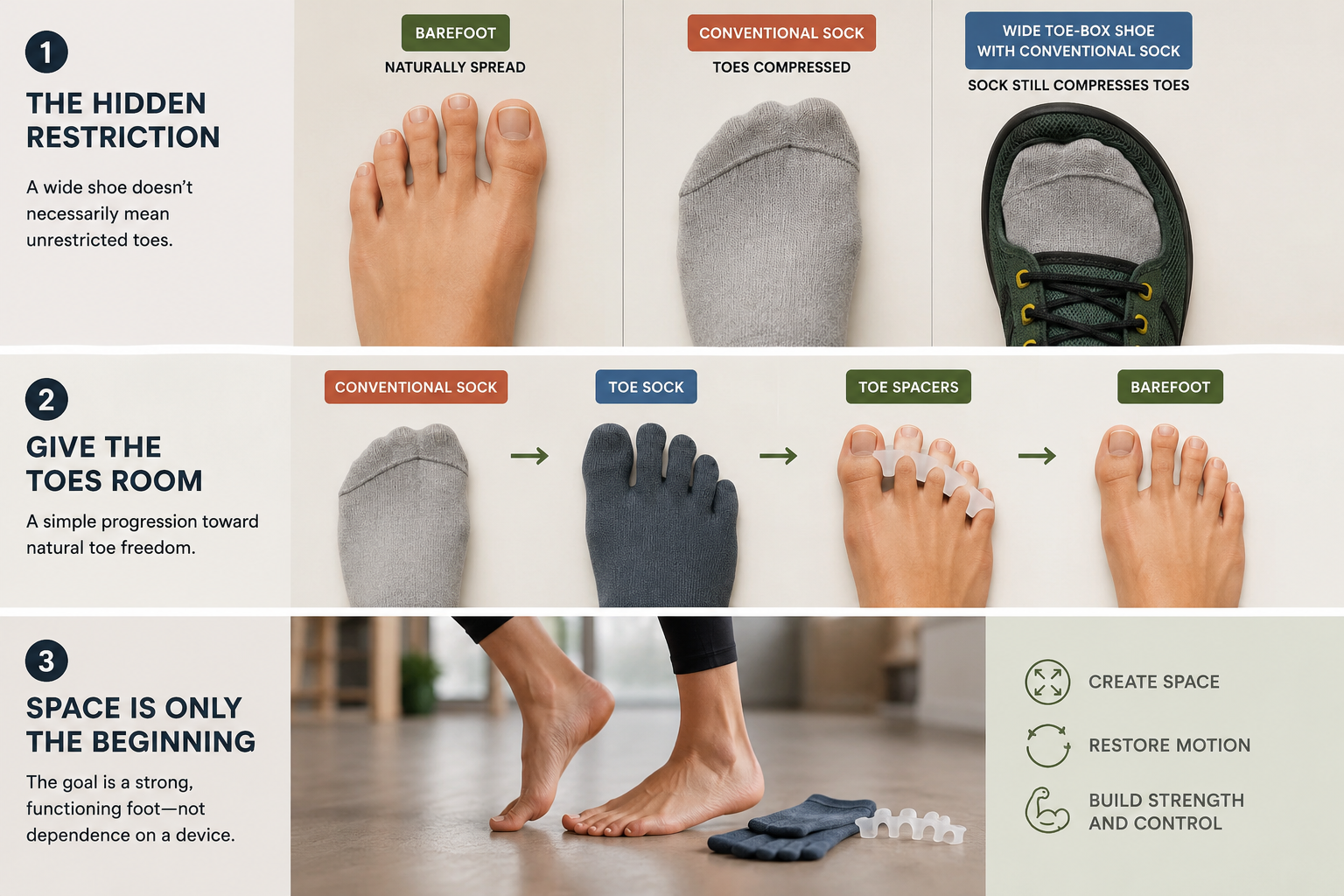
Space Versus Strength
This is the distinction I think gets lost online.
A toe spacer can place the toes into a different position. Your muscles still need to learn to control that position. Creating additional range or separation is useful only if the foot can eventually use it.
Create space. Restore motion. Then build strength and control.
Toe spacers may contribute to the first two. Foot exercises, barefoot activity, balance work, appropriate footwear, walking, and progressive loading are what help develop the third.
What Does the Research Actually Say?
The evidence is interesting, but it is not strong enough to justify many of the sweeping claims made about toe spacers online.
In women with moderate symptomatic hallux valgus, a randomized clinical trial found that a three-month program combining foot mobilization, strengthening, stretching, and a toe separator improved pain, function, strength, range of motion, and radiographic measures compared with no intervention at three months and one year. Because the treatment was multifaceted, the study cannot tell us how much of the improvement came from the spacer itself.
A separate randomized trial of custom-mold silicone toe separators in people with moderate hallux valgus found a reduction in hallux valgus angle and pain after 12 months compared with controls.
However, a newer 2026 randomized trial in healthy young adults found that six weeks of foot strengthening improved hallux alignment and mobility, but adding a silicone toe spacer did not provide additional short-term benefit over exercise alone for most outcomes.
That is exactly the kind of nuance I want the Footwear Lab to preserve.
Strength Still Matters
A 2025 systematic review and meta-analysis of 28 randomized trials found that foot exercises and minimalist footwear may improve aspects of foot strength and muscle size, including greater strength of toes two through five with minimalist footwear.
The certainty of the evidence was low to very low, so this should not be interpreted as proof that minimalism is universally superior.
It does reinforce the larger principle: giving the foot room is only part of the equation. The foot also needs progressive muscular demand.
How I Would Use Toe Spacers
I do not view toe spacers as something that everyone needs to wear all day.
For someone who has spent years in narrow footwear, I prefer them as a controlled exposure: around the house, during selected mobility or strengthening exercises, or during periods of barefoot activity.
Some people eventually tolerate them while walking or inside sufficiently wide footwear. Others simply do not like them.
More is not automatically better. Pain, numbness, skin irritation, color change, or significant discomfort are reasons to remove them rather than assuming the foot needs to “push through” the adaptation.
The Bigger Point
Toe spacers are interesting, but they are not actually the most important part of this discussion.
The important part is remembering that toes are supposed to move.
We spend enormous amounts of time discussing arch support, cushioning, pronation, heel drop, carbon plates, and shoe technology while sometimes ignoring five structures sitting directly at the end of the foot that participate in nearly every step we take.
A foot-shaped shoe provides room.
A nonrestrictive sock preserves that room.
A toe spacer may temporarily encourage separation.
But ultimately, the goal is not beautifully separated toes.
The goal is toes that can move, sense, stabilize, and produce force when the body needs them.
Footwear Lab Insight
Don’t buy a wide toe-box shoe and then unknowingly recreate the same restriction inside it. The shoe, the sock, and the foot all have to work together.
A new product that I Love: Tabio’s five-toe grip socks give each toe its own space while the silicone grip underneath helps reduce slipping inside a cleat—exactly what I want from a performance sock when the shoe itself is already tight and highly task-specific. I also love that they’re meticulously crafted in Japan, where the modern five-toe sock tradition has deep roots, with Tabio reporting that each football sock takes about 50 minutes to knit.
Key Takeaways
Toe function matters for balance, stability, arch mechanics, and propulsion.
A wide toe box provides space but does not automatically restore toe strength or control.
Socks are an active part of the foot-footwear system; current evidence shows effects on pressure, sensation, and in-shoe movement, but does not prove ordinary socks cause deformity.
Toe socks preserve individual toe compartments, although direct evidence for long-term functional benefits remains limited.
Toe spacers can provide a positional stimulus and may help selected people, particularly in hallux valgus, but they are not a stand-alone solution.
The long-term objective is active toe mobility, strength, and control—not dependence on another device.
Volume III: Barefoot vs. Cushioned Footwear: What the Research Actually Says