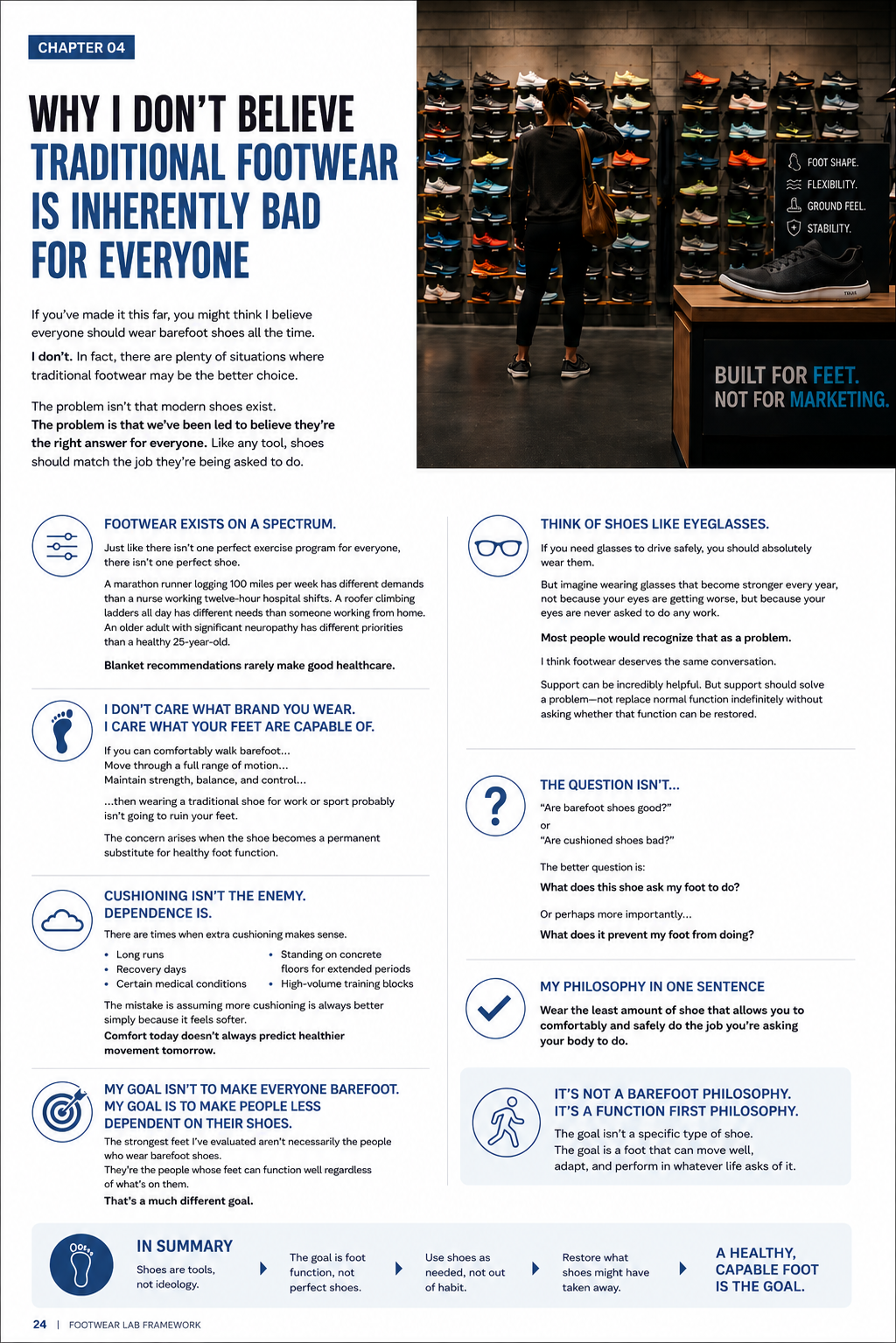
The goal is not to make everyone barefoot. The goal is to make feet more capable.
The misconception
One of the easiest assumptions to make after reading about minimalist footwear is that I want
everyone to throw away traditional shoes. I do not. I use different footwear for different activities, and I recommend different levels of cushioning and protection depending on the person in front of me.
Traditional footwear is not inherently harmful, just as barefoot footwear is not inherently therapeutic. Both categories alter movement and distribute demand. The value of those changes depends on context.
Shoes are tools, not ideologies
A hammer is not better than a screwdriver. The right tool depends on the job. Footwear works the same way: a thin flexible shoe can increase sensory input and muscular demand, while a cushioned shoe can improve comfort, protection, and tolerance for volume.
The mistake is not using either tool. The mistake is assuming one tool is always correct, regardless of the person, surface, activity, history, or current tissue capacity.
The shoe gives me clues. The foot tells me the story.
Footwear is one of the first things I notice during an evaluation, but it is not a diagnosis. I have assessed runners in heavily cushioned shoes with excellent foot strength and control. I have also assessed people in barefoot shoes whose feet were surprisingly weak.
A logo cannot tell me whether the toes move, the arch controls load, the calf has capacity, or the person can balance. Those answers come from the individual, not the category.
We Have Been Taught Not to Trust Our Feet
External support can be useful. The mistake is assuming the foot is incapable of creating stability on its own. The foot is not a passive structure Many of us have been led to believe that the human foot is inherently unstable - that it needs cushioning beneath it, arch support underneath it, and motion-control features around it in order to function properly. For most healthy feet, I do not believe that is true. The foot is a complex system of bones, joints, muscles, tendons, ligaments, and sensory receptors designed to support the body, adapt to the ground, absorb and transfer force, and actively contribute to stability.
But where is the support?
When people first see a barefoot shoe, one of the most common reactions I hear is, "But where is the support?" That reaction shows how deeply we have learned to equate more material under the foot with more support for the foot. Those are not necessarily the same thing. A shoe can provide external support, while the foot itself also has an active capacity to create and control stability.
What I have seen clinically
I am generally against blanket statements, so I make this observation carefully: every patient I can recall treating who had previously seen a podiatrist for a foot-related complaint had been prescribed an orthotic. That does not mean every podiatrist practices this way, and it does not mean those orthotics were inappropriate. But when the same solution repeatedly appears across people with very different feet, symptoms, activities, and physical capacities, I think it is reasonable to ask whether we are evaluating what the foot can do before deciding that it needs external support.
FOOTWEAR LAB INSIGHT
My concern is not the orthotic. My concern is the assumption behind it.
Support Is a Tool, Not a Requirement
Before deciding that support should be permanent, I want to know what the foot is capable of doing for itself.
Evaluate capacity before assuming dependence
Can the arch actively control load? Can the toes spread and contribute to stability? Can the great toe move appropriately? Can the foot adapt to the ground? Can the intrinsic and extrinsic foot muscles produce and control force? If those abilities are impaired, can we train them? There will absolutely be people for whom an orthotic is appropriate. But pain, pronation, a low arch, or another variation in foot structure should not automatically mean that the foot is incapable of supporting itself.
Pronation is not a four-letter word
Pronation is a normal and necessary part of how the foot becomes mobile, adapts to the ground, and manages load. Seeing an arch lower during weight bearing does not automatically mean the foot is unstable or needs motion-control footwear or an orthotic. I care more about whether the person can control the motion, whether its timing and amount fit the task, whether the foot can move back out of pronation, and whether the movement is actually related to the person's symptoms. A rigid, highly supinated foot that cannot pronate enough can create problems too. The goal is not to eliminate pronation; it is a foot that can move into and out of it when the task requires.
Why I am cautious about long-term orthotic use
One reason I am generally cautious about orthotics is the potential to become dependent on external support. Once someone becomes accustomed to an orthotic, every shoe may need to accommodate it. That does not make the orthotic bad; it means we should periodically ask whether the same amount of support is still necessary.
When I do advocate for orthotics
I have recommended orthotics for athletes dealing with foot pain in the middle of a competitive season. Temporarily reducing stress on an irritated structure may help an athlete continue participating while we manage symptoms and workload. When the season is complete, I strongly advocate reassessing and, when appropriate, gradually weaning out of the orthotic while addressing foot strength, mobility, load tolerance, balance, movement mechanics, footwear, and the reasons support was needed.
The goal
The goal is not simply to take support away. The goal is to build enough capacity that the person no longer needs as much of it. Sometimes support is exactly what the foot needs today. That does not necessarily mean it should need the same support forever.
FOOTWEAR LAB INSIGHT
Evaluate -> support when necessary -> build capacity -> reassess -> reduce support when appropriate.
Why I often recommend the Altra Escalante
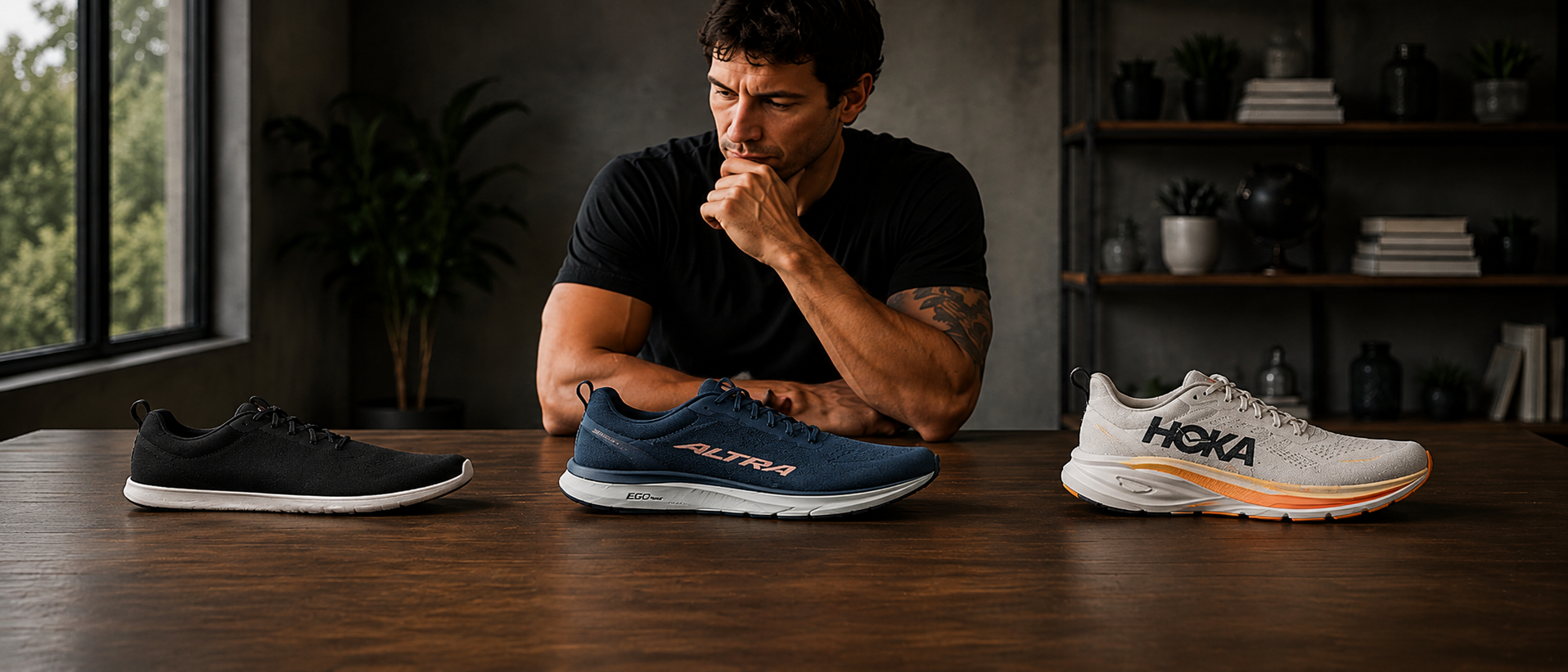
One of the shoes I recommend frequently is the Altra Escalante. Its foot-shaped forefoot, level platform, and moderate cushioning make it a useful option for people who need more protection than a true minimalist shoe provides or who are not ready for a very thin sole.
That recommendation does not conflict with a function-first approach. It demonstrates it. The Escalante can serve as a practical bridge, an all-day shoe, or simply the right long-term tool for someone whose goals and preferences match the design.
Cushioning is not the enemy. Dependence is the concern.
There are legitimate reasons to choose cushioning: long runs, high-volume training, recovery days, hard work surfaces, symptoms that require temporary load modification, and personal comfort. Those benefits should not be dismissed.
The more useful question is whether the feet retain strength, mobility, balance, and adaptability when the shoe is removed. Support can be valuable without becoming a permanent substitute for every aspect of function.
The best shoe can change
The best shoe during recovery from a stress injury may be different from the best shoe six months later. The shoe used for a rocky trail does not have to be the shoe used for squatting. A nurse working twelve hours on concrete and an athlete performing short agility drills are solving different problems.
Footwear recommendations should evolve with the task and the person. That is not inconsistency; it is clinical reasoning.
What you might see me wear
During an ordinary week, you may see me in Vivobarefoot or Tolos, Xero sandals, or with no shoes at all. I am not loyal to a category.
The purpose of the Footwear Lab is to become educated enough to choose deliberately - not to trade one form of brand loyalty for another.
My philosophy in one sentence
Wear the least amount of shoe that allows you to comfortably and safely do the job you are asking your body to do.
That is not a barefoot philosophy. It is not even a shoe philosophy. It is a movement philosophy.
Why I Do Not Believe Traditional Footwear Is Inherently Bad
The Training Room Footwear Lab • Volume V of VIII
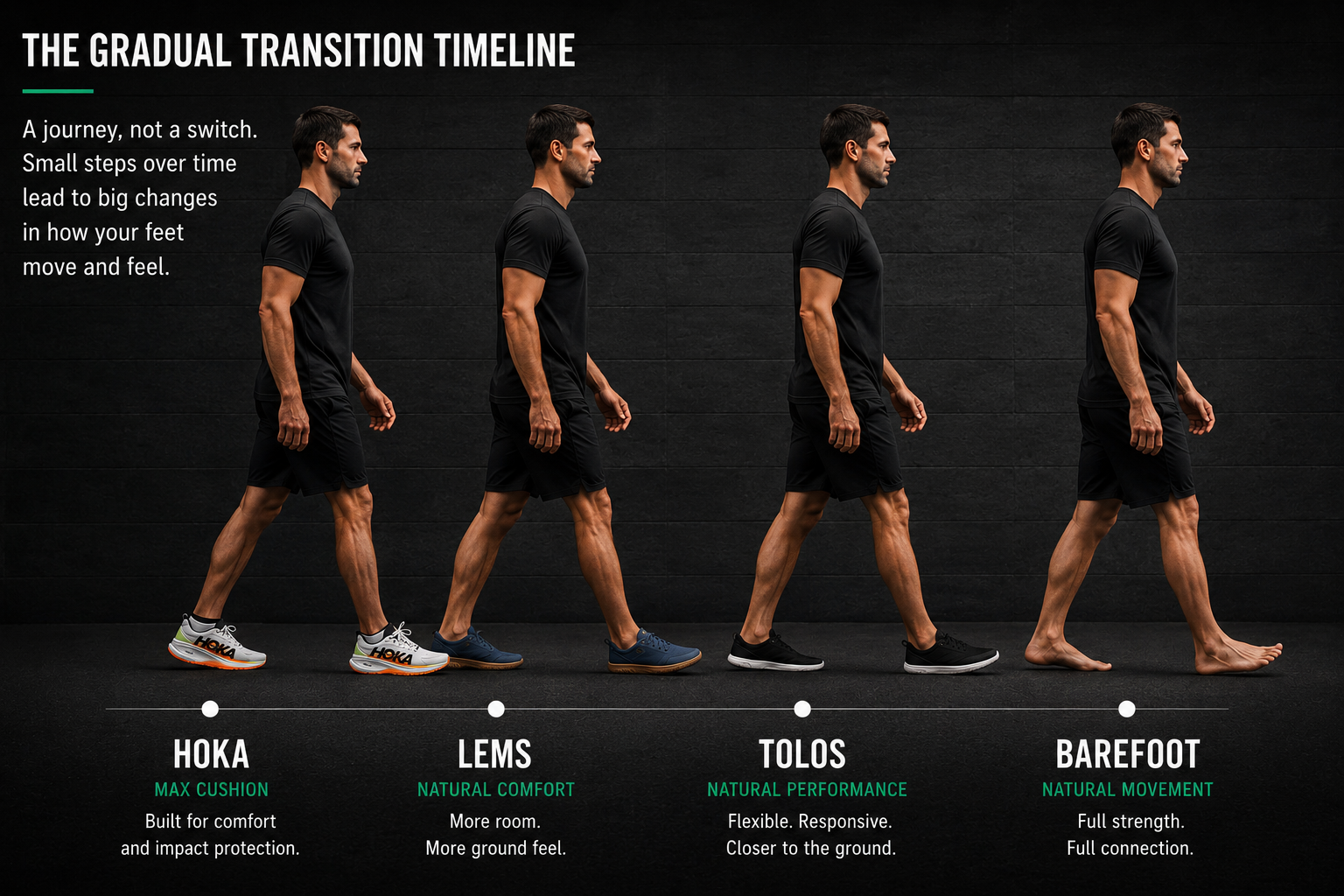
Final thoughts
If this website convinces someone to buy a different shoe but never changes the way they think about their feet, it has missed the larger purpose. The goal is to understand the structure at the bottom of every step and to choose footwear that serves the person rather than the marketing.
A barefoot shoe is not the destination. A healthy, adaptable foot is.
Volume VI: How to Transition into Barefoot Shoes Without Getting Hurt