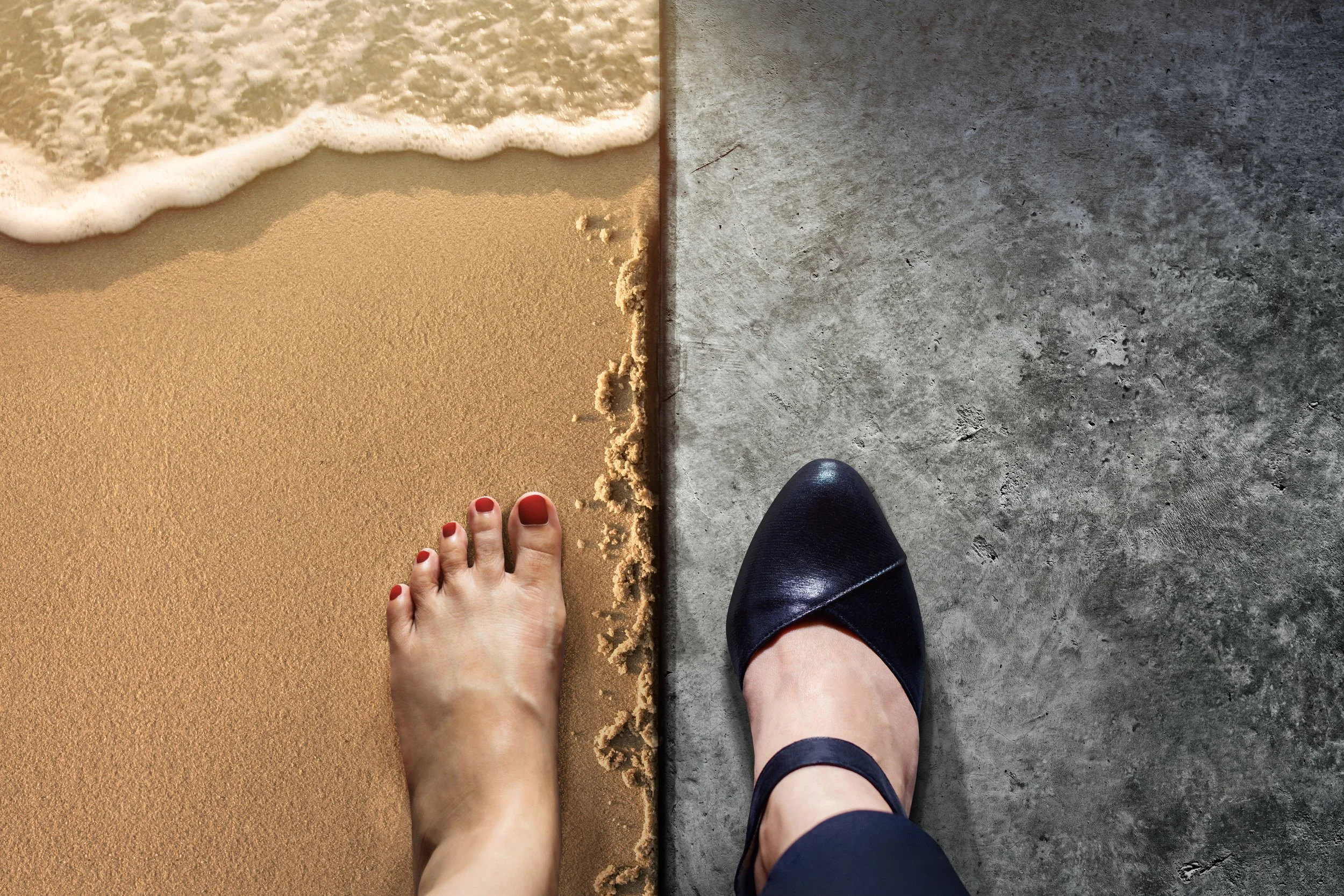
Why Barefoot Shoes Changed the Way I Think About Movement
The Training Room Footwear Lab • Article 1 of 6
I Thought Running a Marathon Meant My Feet Were Strong. I Was Wrong.
After finishing a full marathon, I assumed my legs and feet were in pretty good shape. I had spent months training, logged hundreds of miles, and thought of myself as one of the better recreational runners around. I was not pain-free, however. I continued to deal with nagging knee and hip joint pain, which I mostly attributed to the mileage and accumulated stress of training.
As a physical therapist, I had heard the arguments surrounding barefoot shoes for years. Some people described them as the answer to nearly every lower-extremity problem, while others dismissed them as a fad. I had never felt strongly enough in either direction to investigate them seriously. Eventually, curiosity won. I bought a pair of Merrell Vapor Gloves and took them out for what I expected would be an easy run.
I barely made it seven minutes.
The surprising part was not that my knees or hips hurt. They did not. Instead, the muscles in my feet, calves, and lower legs were burning in a way that I could hardly believe. I had just completed a marathon and the training required to get there, yet a few minutes in a thin, flexible shoe exposed an entirely different type of fatigue.
My joint pain had largely disappeared during that short run, but it had been replaced by intense muscular work. That experience did not prove that barefoot shoes were better, and it certainly did not mean I was ready to run meaningful mileage in them. It did make one thing clear: being aerobically fit and capable of running a marathon did not necessarily mean that my feet and lower legs were prepared to manage load without the assistance of a modern running shoe.
That seven-minute run sent me down a rabbit hole. I began looking at how footwear changes movement, why the same person may run differently in a thick cushioned shoe than in a thin flexible one, and how dozens of small footwear companies were approaching foot shape, ground feel, cushioning, durability, and performance in completely different ways.
The force does not disappear
Modern athletic shoes are very good at making the ground feel softer. Foam, heel elevation, rocker geometry, plates, and other structural features can make walking and running more comfortable and efficient for many people. The mistake is assuming that because impact feels softer, the underlying forces have disappeared. They have not. Footwear influences how those forces are distributed, how quickly they are applied, and which tissues are asked to manage them.
A cushioned heel can make it more comfortable to contact the ground farther in front of the body. Some runners continue to land close to their center of mass, while others adopt a longer stride and a more pronounced rearfoot strike. Neither foot strike alone determines whether someone will be injured, but overstriding can increase braking forces and change loading at the knee and hip.
When most of the cushioning is removed, a hard landing becomes immediately noticeable. Many people respond without consciously trying: the stride shortens, cadence may increase, the foot lands closer to the body, and the ankle, calf, and intrinsic foot muscles contribute more to controlling the landing. The workload has not vanished; it has shifted.
Why my muscles burned
The Merrell Vapor Glove is extremely flexible, zero-drop, and only a few millimeters thick. It provides little opportunity to hide a heavy landing. My feet and ankles had to control motion, maintain stiffness where needed, and absorb force in ways that my previous shoes had partially assisted or altered.
Marathon training had developed my cardiovascular system and my ability to tolerate a very specific pattern of repeated loading. It had not automatically prepared my calf complex, Achilles tendon, metatarsals, and intrinsic foot muscles for an abrupt change in footwear and mechanics. The burning was not proof that my previous shoes had damaged me, nor was it proof that the new shoes were fixing me. It was evidence of a major change in demand.
This distinction matters. Muscle soreness can be a normal response to a new activity. Tendon pain, bone pain, swelling, altered gait, or symptoms that worsen from one session to the next are different. A new shoe can expose capacity limitations, but simply pushing through them is not a strengthening program.
What actually defines a barefoot shoe?
The term barefoot shoe is used loosely. A shoe does not become barefoot simply because it is light or because the marketing includes the phrase “natural movement.” Most true barefoot shoes share four characteristics:
A foot-shaped toe box that allows the toes to spread rather than tapering them inward.
Zero heel-to-toe drop, meaning the heel and forefoot sit at approximately the same height.
A thin, highly flexible sole that bends and twists with the foot.
Minimal cushioning and minimal structural control.
There is also a large middle ground. Transitional shoes may be zero-drop and foot-shaped while still providing enough material underfoot for long days on concrete, travel, or a gradual transition. That category should not be viewed as a failure to be truly barefoot. For many people, it is the most practical long-term solution.
Barefoot is not automatically better
The barefoot discussion often becomes unnecessarily absolute. One side argues that modern shoes have weakened everyone’s feet. The other argues that minimalist shoes are dangerous and unsupported. The reality is more individual.
A person with adequate tissue capacity, good sensation, and a gradual progression may benefit from spending more time in flexible, foot-shaped shoes. Another person may need cushioning because of a medical condition, recent injury, prolonged standing demands, or limited tolerance to forefoot and Achilles loading. Some athletes perform best with a rotation that includes both minimalist and cushioned footwear.
The question is not, “Which type of shoe is universally correct?” The better question is, “What does this shoe ask my body to do, and am I prepared for that demand?”
What I learned when I started researching the market
I expected to compare a few familiar names. Instead, I found a large and rapidly growing market. Some brands build shoes primarily for athletic performance. Others prioritize the widest and most anatomical shape possible. A third group tries to hide barefoot geometry inside a normal-looking lifestyle sneaker. Transitional companies preserve toe room and a level platform while adding more protection underfoot.
I also learned that “wide” does not always mean foot-shaped. A shoe can be broad at the metatarsal heads and still taper sharply across the toes. Likewise, the shoe with the thinnest sole is not automatically the healthiest or most advanced. Ground feel, durability, heel security, upper containment, outsole geometry, and intended use all matter.
Why this matters beyond running
My original experiment started with running, but the larger lesson applies to walking, strength training, hiking, and daily life. During lifting, a broad and stable base can improve contact with the ground. During walking, a flexible shoe can allow the foot to move more freely, but excessive thinness may be uncomfortable when someone is unprepared for long hours on hard surfaces. During hiking, traction and protection often matter more than achieving the lowest possible stack height.
Footwear is a tool. The right tool depends on the task, the foot inside it, and the person’s current capacity.
Final thoughts
That first seven-minute run did not turn me into a barefoot purist. It made me more curious and more careful. It reminded me that fitness is specific, that the body adapts to the stresses we repeatedly place upon it, and that reducing pain in one area does not mean the entire system is prepared for a sudden change.
Barefoot shoes changed the way I think about movement because they made the tradeoffs impossible to ignore. Cushioning can improve comfort but does not eliminate force. Minimalism can increase muscular demand but does not automatically produce better mechanics. A wider toe box can create room, but fit still depends on foot shape, volume, and heel security.
The most useful outcome of the barefoot movement may not be convincing everyone to wear the same type of shoe. It may be that it has forced the footwear industry—and the people buying shoes—to ask better questions.